
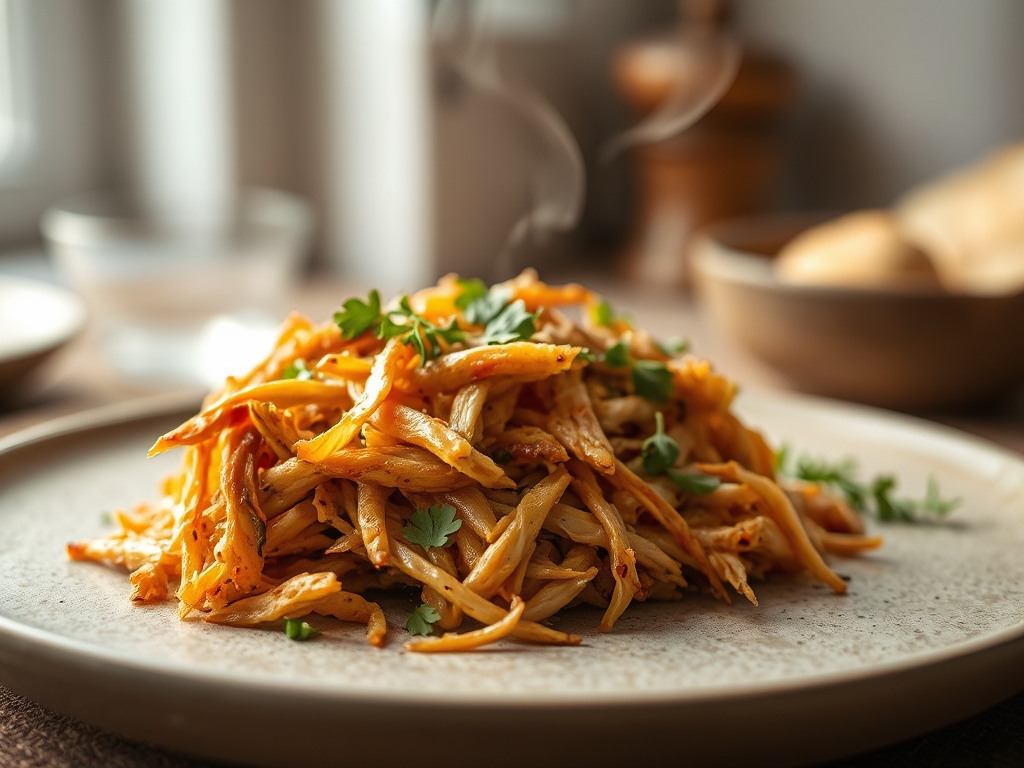
The moment a rotisserie chicken emerges from the oven, its mahogany skin crackling under the heat lamps, something primal awakens in the kitchen. That intoxicating blend of rendered fat, caramelized skin, and deeply savory aromatics signals what comes next: transformation into shredded rotisserie chicken recipes that span everything from quick weeknight tacos to elegant composed salads. Shredded rotisserie chicken has become the backbone of modern meal prep, not merely as a shortcut but as a legitimate cooking technique that unlocks layers of umami and textural complexity when approached with precision. What separates a forgettable shred from a restaurant-quality one lies in temperature control, timing, and understanding the protein matrix itself. This guide walks through seven strategic approaches that will make your shredded rotisserie chicken recipes faster, more flavorful, and endlessly versatile across your cooking repertoire.
The magic of shredded rotisserie chicken begins before any shredding occurs. Your success hinges on understanding what happens to muscle fiber and collagen during the roasting window, then leveraging that knowledge to maximize texture and moisture retention.
Ingredient Mise-en-Place and Smart Substitutions
As you see in the ingredient spread below, a proper rotisserie setup demands minimal components but maximum intention. You'll need a whole bird (preferably 1.4-1.6 kg / 3-3.5 lbs), kosher salt, freshly cracked black pepper, garlic powder, smoked paprika, dried thyme, and neutral oil with a smoke point above 190°C (375°F). The skin benefits from a light coating of vegetable oil or duck fat; this accelerates the Maillard reaction at the surface while the proteins below remain insulated at a gentler 65-73°C (150-165°F) internal temperature.
Smart Substitutions: Swap paprika for sumac if chasing bright acidity; replace thyme with oregano for Mediterranean inflection; use ghee instead of oil for deeper, toasted notes. For poultry-free cooking, portobello mushroom caps deliver umami-rich shredding capability, though the protein-to-fiber ratio differs significantly.
The Clock: Timing and Chef's Flow
Total time runs 60-75 minutes from ambient temperature to fork-shredded bird. Breakdown: 15 minutes for prep and seasoning, 50-60 minutes roast time at 200°C (400°F), and 10 minutes passive carryover and resting. During this window, collagen converts to gelatin, and the carry-over heat coast brings residual temperature gain of 2-3°C without additional oven exposure.
Chef's Flow Optimization: While your bird roasts at the 30-minute mark, prep your shredding station. Lay out two sheet pans, two forks, a fine mesh sieve, and your holding vessel. This eliminates fumbling when the bird exits the oven and achieves maximum heat retention during the critical shredding phase.
The Masterclass: Seven Brilliant Techniques
Tip 1: Spatchcock Before Roasting
Remove the backbone with kitchen shears, then press the breastplate flat against the sheet pan. This reduces roast time by 15 minutes and ensures uniform browning. The flattened geometry means skin-side-up exposure to radiant heat from all vectors, creating a more consistent crust. Internal temperature reaches 73°C (165°F) at the thickest point in under 40 minutes.
Why It Works: Traditional trussing concentrates heat around the thighs while the breast cooks slower. Spatchcocking eliminates thermal gradient variance. Radiant heat at 200°C (400°F) penetrates the flattened frame more evenly, and the reduced mass density means faster collagen breakdown and gelatin infusion into the meat.
Tip 2: Dry Brine for 12-24 Hours Beforehand
Coat the entire bird inside and out with kosher salt at 1.25% of body weight (roughly 18-20 grams). Refrigerate uncovered on a wire rack. This allows enzymatic breakdown of myosin and actin filaments, increasing water retention by 10-15%.
Chef's Secret: The salt penetrates cell membranes through osmotic action, denatures muscle proteins, and creates a drying chamber that paradoxically locks moisture inside. When shredded, dry-brined chicken shreds more cleanly and maintains juiciness for 3-4 days post-cook.
Tip 3: Use Two Forks with One Anchoring Motion
Position your bird breast-up on a cutting board. Hold one fork stationary, pressed vertically into the thigh, while the other fork pulls meat toward you in swift, deliberate strokes. This mimics professional kitchen technique and preserves fiber integrity.
Why It Works: Pulling rather than tearing prevents shattering the protein fibers into dust. You maintain medium-length shreds (3-5 cm) rather than a paste. Consistent shred size means even distribution in recipes and superior texture perception.
Tip 4: Shred While Still Hot (65-70°C / 150-158°F)
Begin shredding within 2-3 minutes of pulling the bird from the oven. The residual heat keeps collagen pliable and fibers supple. Cold chicken meat, conversely, becomes rigid and shreds unevenly.
Chef's Secret: Heat maintains the gelatin film surrounding each muscle bundle. As the bird cools, this gel sets, and muscle fibers become brittle. Shredding at temperature preserves the tender, cohesive structure.
Tip 5: Capture the Skin and Reserve the Fond
Never discard skin or pan drippings. Roughly chop the skin and fold it back into the shredded meat. Deglaze the roasting pan with 120 ml (0.5 cup) chicken stock, scraping browned bits with a wooden spoon. This fond, rich in umami compounds (glutamates and nucleotides), adds complexity to any sauce.
Why It Works: Rendered chicken skin contributes fat-soluble flavor compounds and textural contrast. The fond contains polymerized Maillard products and caramelized proteins. Together, they create a stock base 3-4x more flavorful than unseasoned liquid.
Tip 6: Season Aggressively After Shredding
Before storing or serving, taste the shredded meat. Add fleur de sel, cracked pepper, and acid (lemon juice or champagne vinegar) to taste. Many home cooks undersalt; proper seasoning requires 0.8-1.0% salt by weight of finished product.
Chef's Secret: Seasoning post-cook allows you to taste and adjust. Pre-seasoning locks flavor into the interior, but it can't adapt to the final dish context. A light hand during roasting, then precise adjustment post-shred, yields superior control.
Tip 7: Proof Your Shred with the Bind Test
Mix 100 grams of shredded chicken with 2 tablespoons of mayo and 1 tablespoon of your reserved jus. Stir gently. Quality shred should hold together without breaking into threads, showing a cohesive, creamy structure.
Why It Works: This test confirms fiber integrity and gelatin content. Poor shred will fragment into disconnected pieces, signaling either over-cooking, over-aggressive shredding, or insufficient resting time. Adjust your next bird accordingly.
Nutritional Information
Per 100-gram serving of unseasoned shredded rotisserie chicken (skin-on): 165 calories, 11.2g protein, 13.4g fat (4.1g saturated), 0g carbohydrate, 0g fiber, 320mg sodium. Micronutrient highlights include 8 mcg selenium (14% DV), 3.2 mg niacin (16% DV), and 0.08 mg thiamine (7% DV). The ratio shifts significantly if skin is removed; skinless yields 120 calories per 100g with 7.2g fat and 22g protein, emphasizing lean protein over richness.
Dietary Swaps
Keto Enthusiasts: The skin-on preparation is naturally keto-aligned (0g net carbs, high fat, moderate protein). Calculate macros based on your specific bird and fat content. A whole bird yields roughly 40g net fat from skin and subcutaneous layers.
Gluten-Free: Standard rotisserie preparation is inherently gluten-free. Cross-contamination risks arise only if using seasoning blends with gluten-containing additives. Always verify paprika and spice blends sourced from bulk bins.
Vegan Pivot: Portobello mushroom caps, pressed and roasted at 190°C (375°F) for 35 minutes, develop meat-like texture. Brush with miso-infused oil (3 tbsp white miso, 60 ml oil, 1 tbsp rice vinegar) before roasting. The umami-forward profile approximates poultry savory notes. Alternatively, young jackfruit, shredded and seasoned with smoked paprika and garlic, provides textural mimicry, though nutritional profile differs entirely (higher carbs, minimal protein).
Serving and Presentation: High-End Plating Ideas
Idea 1: Composed Salad with Charred Brassica. Arrange shredded chicken atop a bed of charred broccolini and crispy chickpeas. Dress with a warm apple cider vinaigrette (3 tbsp cider vinegar, 1 tbsp Dijon mustard, 2 tbsp shallot, 60 ml neutral oil). Finish with toasted almonds and microgreens. The warm shred contrasts with cool greens and crispy legumes.
Idea 2: Crispy Skin Tostada Stack. Layer warm corn tortillas with refried black beans, shredded chicken, crispy skin shards (reserved and crisped under the broiler), pickled red onion, cilantro, and a quenelle of crema. Plate standing upright for height and visual drama.
Idea 3: Asian-Inspired Rice Bowl with Burnt Garlic Oil. Crown jasmine rice with warm shredded chicken, soft-boiled egg (63°C yolk), cucumber ribbon, and crispy fried shallots. Dress with a burnt garlic oil (60 ml oil, 12 cloves garlic sliced thin, toasted until mahogany in a small pan, strained, finished with 1 tsp sesame oil).
The Pro-Dodge: Common Pitfalls and Fixes
Pitfall 1: Dry, Stringy Shred. Root cause is over-cooking beyond 73°C (165°F) internal temperature or shredding after the meat has cooled. Fix: Use an instant-read thermometer, pull at 73°C exactly, and shred within 2-3 minutes. Never wait more than 5 minutes before beginning the shred.
Pitfall 2: Meat Glued into Dense Clumps. This occurs when shredding cold meat or exerting too much pressure with the forks. Fix: Reheat in a low oven (65°C / 150°F) for 5 minutes if necessary. Use lighter fork pressure and a pulling motion rather than grinding.
Pitfall 3: Bland, One-Note Flavor. Under-seasoning during roasting and failure to capture fond or skin. Fix: Dry brine 12+ hours, season aggressively post-shred, and fold in pan jus and rendered skin. Taste continuously and adjust.
The Meal Prep Corner: Storage and Reheating for Day-One Quality
Store shredded chicken in an airtight container at 4°C for up to 4 days. For freezing, portion into 150-gram servings in vacuum-seal bags, removing excess air with a straw. Freeze for up to 3 months. Thaw overnight in the refrigerator, never at room temperature.
Reheating Protocol: Transfer to a shallow baking dish, add 2 tablespoons of chicken stock per 150 grams of meat, cover with parchment paper, and warm in a 65°C (150°F) oven for 12-15 minutes. The low, moist heat regenerates moisture without overcooking fibers. Alternatively, reheat gently in a covered skillet over medium-low heat with stock, stirring every 90 seconds. Total time runs 5-7 minutes.
Never use a microwave for reheating; radiant heat causes uneven warming and accelerates moisture loss through explosive evaporation.
The Wrap-Up
Shredded rotisserie chicken transforms from cafeteria shortcut into a refined technique when you honor the science. Temperature precision, timing awareness, and aggressive finishing elevate your results. These seven strategies work in concert, not isolation; dry brine informs shredding ease, spatchcocking accelerates cook time, and immediate seasoning locks flavor. Your shredded rotisserie chicken recipes will benefit from this foundational mastery, whether destined for quick lunches or composed plating.
I'd love to hear your own rotisserie wins. Share your favorite application or your biggest pitfall in the comments below; let's troubleshoot together.
The Kitchen Table: FAQ
Q: Can I shred a store-bought rotisserie chicken the same way?
A: Yes, with caveats. Commercial birds are often over-cooked to 76-80°C (170-175°F) for food safety margins, making them slightly drier. Shred immediately and fold in 2-3 tablespoons of bone broth per bird to restore moisture. The technique remains identical; the starting texture merely requires compensation.
Q: How do I know when my chicken is done without cutting into it?
A: Use an instant-read thermometer inserted into the thickest part of the inner thigh without touching bone. Target 73°C (165°F). At this temperature, pathogens die off, and moisture retention remains maximized. Pull at 72°C if your oven runs hot; carryover will finish it to safe temps within 2-3 minutes.
Q: What's the difference between shredding, slicing, and dicing the same bird?
A: Shredding breaks fiber along the grain, creating long strands that trap sauce and bind cohesively in dishes like tacos and pasta. Slicing cuts across the grain, yielding clean, presentable pieces for composed plates. Dicing fragments the meat for applications like fried rice or salads where texture uniformity matters. Shredding maximizes moisture retention because the longer fibers maintain internal gelatin coating.
Q: Can I shred while the bird is still hot enough to burn my hands?
A: Wear silicone or heat-resistant gloves rated to at least 260°C (500°F). This eliminates burn risk while maintaining the thermal window. Alternatively, use two forks with a steady rocking motion that keeps fingertips away from the hottest zones. Many professional kitchens employ this fork-only method for speed and safety.
Q: How much shredded chicken do I get from one whole bird?
A: A 1.4-1.6 kg (3-3.5 lb) bird yields approximately 450-550 grams of usable shredded meat, accounting for bone, skin weight (if reserved separately), and moisture loss during cooking. This translates to three to four generous portions or six lighter servings, depending on your application and accompanying components.